
A short history of St John’s and its parish
From a chapel for a new London estate in 1832 to a centre of worship, music and community today.
St John’s Hyde Park honours its rich past while meeting present challenges with imagination and grace. From its foundation in a newly emerging London neighbourhood to its place as a centre of worship, culture and community today, it remains a living symbol of faith, heritage and hospitality.
Four chapters in the life of the parish
Early history of the area
For centuries, Paddington was a rural village marked by Tyburn Tree, London’s principal site of public executions. The infamous gallows could accommodate up to 23 simultaneous hangings and stood near today’s Marble Arch until executions were moved to Newgate Prison in 1783. This macabre legacy gave way to development.
The 1795 Building Act unlocked the land for new construction. In 1807, architect Samuel Pepys Cockerell began work on the elegant Tyburnia estate, characterised by grand stuccoed houses and classical squares. Connaught Place and Connaught Square were among the first developed, attracting aristocratic residents like Princess Caroline of Ansbach and her daughter, Princess Charlotte.
Nearby, Tyburn Convent was founded in 1901 by Mother Marie Adele Garnier. It stands near the original site of the gallows and commemorates the Catholic martyrs who perished there during the Reformation. The convent remains a site of pilgrimage and is home to the Benedictine Adorers of the Sacred Heart of Jesus of Montmartre.
Several notable figures lived nearby or worshipped at St John’s, including W.H. Smith (bookseller and churchwarden), Percy Dearmer (liturgist and hymnologist), and novelist William Makepeace Thackeray. Blue plaques around the parish mark the homes of these and other figures such as Enid Bagnold, Sir Douglas Bader, and Robert Baden-Powell.

Building the church: St John the Evangelist
In 1826, the Revd Dr Crane petitioned the Ecclesiastical Commissioners to build a church for the growing Paddington Estate. The original plans, drawn by Samuel Pepys Cockerell, were shelved after his death. His son-in-law, Charles Fowler, later famed for Covent Garden Market, was commissioned to deliver a new design. His 13th-century Gothic revival scheme reduced the cost to £8,592 (about £860,000 today).
St John’s was consecrated on 26 January 1832 by Bishop Charles James Blomfield. Designed to seat 1,500 people, 700 in free seats and the rest rented, the church became known as the Connaught Chapel, reflecting the name of the surrounding estate, though its formal title was St John’s Chapel. Its first priest was Revd James Shergold Boone, succeeded by Dr Edward Meyrick Goulburn, who would become Dean of Norwich. In 1859, St John’s became a parish church in its own right.
New parishes soon followed: St James’, Sussex Gardens (1843), All Saints, Norfolk Square (1848, decommissioned 1925), and St Michael’s, Star Street (1864), which developed a strong Anglo-Catholic tradition before being destroyed in WWII. Its altar now resides at St John’s.

Postwar struggles and revitalisation
Following WWII, the area experienced social and architectural decline. Flats replaced single-family homes, and once-grand terraces fell into disrepair. From 1962 to 1965, St John’s occasionally closed its doors.
In 1953, the Church Commissioners bought out the estate’s beneficial leaseholders and sold off or redeveloped much of the area, laying the groundwork for the modern Hyde Park Estate.
Renewal arrived with Captain the Revd Cuthbert Scott, a former naval officer turned priest who brought dynamism and modern engagement. He enlisted leading designers and musicians, launched the cheeky yet beloved ‘Saints & Angels News’, and established Horseman’s Sunday in 1968, a celebration of the area’s equestrian history.
The 2011 renovation marked a new chapter. Victorian pine pews and the wooden floor (covering a defunct coal-fired heating system) were removed. In their place came a stone floor with underfloor heating. The choir screen, a 1911 legacy from Sir Andrew Lusk, was relocated to create a new narthex, and modern amenities such as toilets and a kitchen were installed.

The church today
St John’s is now the sole surviving church in the parish of St John with St Michael and All Angels. It continues to serve a vibrant and diverse congregation in the heart of London.
Music remains central. Each year, the church appoints eight choral scholars and an organ scholar from top conservatoires like the Royal Academy, Royal College of Music, Guildhall School, and Trinity Laban. Services incorporate music from opera, spirituals, musical theatre, and global traditions.
The 1865 Hill organ is one of only four complete Hill instruments in London. Tradition holds that Mendelssohn played its predecessor during his final London tour in 1839–40. This earlier instrument was replaced by the current organ in 1865 and sold the following year to St Mary the Virgin, Ilkeston, for £100.
Stained-glass windows depict the life and parables of Christ in the east window and the story of Joseph in the west. Inside, the reredos salvaged from St Michael’s is an extraordinary visual centrepiece. It features inscriptions and images of Christ, the four Evangelists, the Prophets Isaiah, Jeremiah, Ezekiel, and Daniel, the Ten Commandments, the Lord’s Prayer, and the Apostles’ Creed. Nearby, a tabernacle with a perpetually lit candle houses the reserved sacrament. The church’s war memorials are visible near the entrance, with a larger monument located in the north garden.
The church’s historical interior also included a triforium over each aisle, a spiral pulpit attached to the original rood screen, and a baptismal font from 1862. The font was removed during the 2011 reordering and is expected to be replaced at the west end in due course.

Key dates, 1783 to today
People of the parish
Several notable figures lived nearby or worshipped at St John’s. Blue plaques around the parish mark the homes of many of them.

Download the history leaflet
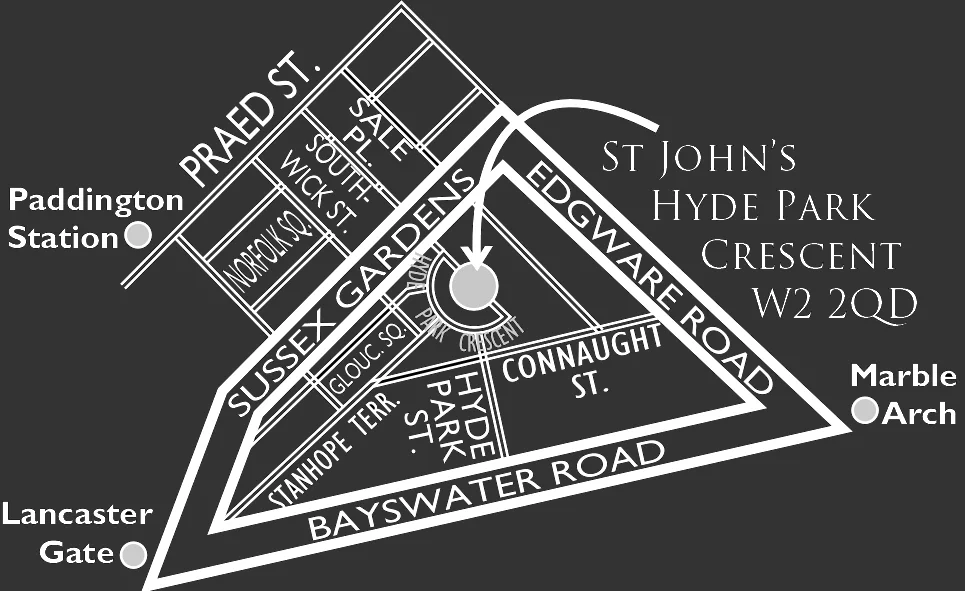
The printed leaflet includes the full history, the timeline and a map of the parish.
Download the leaflet (PDF)St John’s Hyde Park, Hyde Park Crescent, London W2 2QD
History of St John’s Hyde Park
Please click here to download a PDF of the History of St John’s Hyde Park